shineandshape
Building a stronger, leaner body doesn’t require an expensive gym membership, complicated equipment, or hours of exhausting workouts. What it does require is a sensible plan, consistent effort, and exercises that challenge your muscles while supporting your overall fitness.
The most effective routines often rely on fundamental movements. Squats strengthen the legs, push-ups develop upper-body strength, and planks improve core stability. Add walking and a few dynamic exercises, and you have the foundation for a well-rounded fitness program.
However, there’s an important distinction: becoming stronger and developing a leaner appearance are related but different goals. Strength training helps build and maintain muscle, while changes in body fat depend on several factors, including nutrition, activity levels, sleep, and individual physiology.
This guide explores 10 simple exercises to build a stronger, leaner body, explains how to perform them safely, and shows you how to combine them into a practical weekly routine.
What Does It Mean to Build a Stronger, Leaner Body?
A stronger body can produce force more effectively, handle everyday tasks with greater ease, and maintain physical performance as you progress. A leaner body generally refers to having a lower proportion of body fat relative to lean mass, although the ideal balance varies from person to person.
The goal isn’t simply to weigh less. It’s to improve what your body can do while building habits that support long-term health.
The Relationship Between Strength, Muscle, and Body Composition
Resistance exercises challenge muscles and encourage them to adapt. With appropriate training, nutrition, and recovery, these adaptations can improve strength and may increase muscle mass.
Body composition also responds to energy balance. If reducing body fat is appropriate for your goals, maintaining a moderate calorie deficit can help, while resistance training supports muscle retention. You don’t need extreme dieting or daily high-intensity workouts to make meaningful progress.
Why Consistency Matters More Than Complexity
Think of fitness as building a house. A complicated training plan is of little value if you cannot follow it consistently. A straightforward routine that fits your schedule provides a much stronger foundation.
Start with manageable workouts, learn proper technique, and increase the challenge gradually. Regular practice helps you develop movement skills and makes exercise feel less intimidating over time.
1. Squats: Build Lower-Body Strength
<text> </text>
<AsyncImage query=”person performing proper bodyweight squat exercise side view fitness demonstration” aspectRatio=”16:9″ width=”100%” />
Squats are a foundational exercise because they train several major muscle groups simultaneously. They primarily target the quadriceps and glutes while also involving the hamstrings and muscles that stabilize the trunk.
Strong legs support everyday activities such as climbing stairs, standing from a chair, and carrying groceries. Squats are also easy to adapt to different fitness levels.
How to Perform a Squat
- Stand with your feet approximately shoulder-width apart.
- Keep your chest comfortably lifted and your feet firmly planted.
- Push your hips back and bend your knees as if sitting into a chair.
- Lower yourself only as far as you can while maintaining control and a comfortable position.
- Press through your feet to return to standing.
Begin with two or three sets of 8–12 repetitions, adjusting the number to your ability.
Common Squat Mistakes to Avoid
Avoid rushing through repetitions or dropping into a depth you cannot control. Your knees should move naturally in line with your feet, and your heels should remain grounded.
If a full squat feels difficult, start by sitting down onto a sturdy chair and standing back up. As your strength and confidence improve, gradually increase your range of motion or try a more challenging variation.
2. Push-Ups: Strengthen the Chest, Shoulders, and Triceps
<text> </text>
<AsyncImage query=”person demonstrating correct push up exercise straight body alignment side view” aspectRatio=”16:9″ width=”100%” />
Push-ups are an efficient upper-body exercise that requires no weights. They primarily train the chest, shoulders, and triceps while engaging the core to keep your body stable.
The key is maintaining good alignment rather than chasing a high repetition count.
Start in a plank position with your hands slightly wider than shoulder-width apart. Keep your body in a straight line from head to heels, bend your elbows, and lower your chest toward the floor. Push back up without allowing your hips to sag.
If standard push-ups are too difficult, place your hands on a sturdy elevated surface, such as a secure countertop or workout bench. Wall push-ups offer an even easier starting point.
Aim for two or three sets of 5–10 controlled repetitions. Once you can complete your sets comfortably, lower the hand support gradually or increase your repetitions.
3. Lunges: Improve Balance and Leg Strength
<text> </text>
<AsyncImage query=”person performing forward lunge exercise proper posture fitness gym” aspectRatio=”16:9″ width=”100%” />
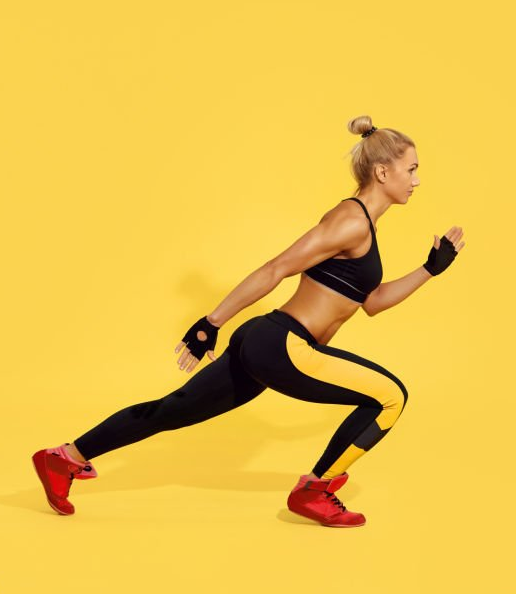
Lunges train the legs one side at a time, making them useful for developing balance, coordination, and lower-body strength. They work the quadriceps and glutes while challenging the muscles responsible for stabilizing the hips.
Stand upright, step one foot forward, and bend both knees as you lower your body. Keep your front foot planted and your torso controlled. Push through the front foot to return to the starting position, then repeat on the opposite side.
Begin with five to eight repetitions per leg. If balance is a concern, hold a stable support lightly or perform stationary split squats instead of stepping forward each time.
Avoid taking a step so short that your movement feels cramped. Your stance should allow you to lower comfortably without losing control. Over time, you can add repetitions or hold light dumbbells to increase resistance.
4. Planks: Develop Core Stability
<text> </text>
<AsyncImage query=”person performing forearm plank exercise correct neutral spine fitness demonstration” aspectRatio=”16:9″ width=”100%” />
A strong core does more than create visible abdominal definition. It helps stabilize the spine and pelvis during movement, supporting activities such as lifting, carrying, and running.
The plank trains the abdominal muscles and other trunk stabilizers without requiring repeated bending of the spine.
Place your forearms on the floor with your elbows beneath your shoulders. Extend your legs behind you and support your body on your forearms and toes. Keep your head, hips, and heels aligned while breathing normally.
Start with holds of 10–20 seconds and repeat two or three times. Gradually extend the duration when you can maintain good form.
The objective isn’t to hold a plank for as long as possible. If your lower back begins to sag or your hips rise excessively, shorten the hold or switch to a knee-supported version.
5. Glute Bridges: Strengthen the Hips and Glutes
<text> </text>
<AsyncImage query=”person performing glute bridge exercise lying on back hips raised fitness mat” aspectRatio=”16:9″ width=”100%” />
Glute bridges target the gluteal muscles and involve the hamstrings and trunk stabilizers. They’re particularly useful for beginners who want to develop hip strength without performing complicated movements.
Lie on your back with your knees bent and your feet flat on the floor. Keep your arms relaxed beside your body. Press through your feet and lift your hips until your shoulders, hips, and knees form a roughly straight line.
Pause briefly at the top, squeeze your glutes gently, and lower your hips with control.
Try two or three sets of 10–15 repetitions. Avoid arching your lower back to lift your hips higher than necessary. The movement should come primarily from your hips, not from forcing your spine into an exaggerated curve.
Once the basic version becomes easy, progress to a pause at the top, a resistance band around your thighs, or a single-leg variation if your balance and strength allow.
6. Bent-Over Rows: Build a Stronger Back
<text> </text>
<AsyncImage query=”person performing bent over dumbbell row exercise flat back neutral spine fitness demonstration” aspectRatio=”16:9″ width=”100%” />
Rows help balance a workout that includes pushing exercises. They train the upper back and involve the muscles around the shoulders and arms.
You can perform this exercise with dumbbells, resistance bands, or another suitable form of resistance. Beginners without equipment can use a resistance band anchored securely according to the manufacturer’s instructions.
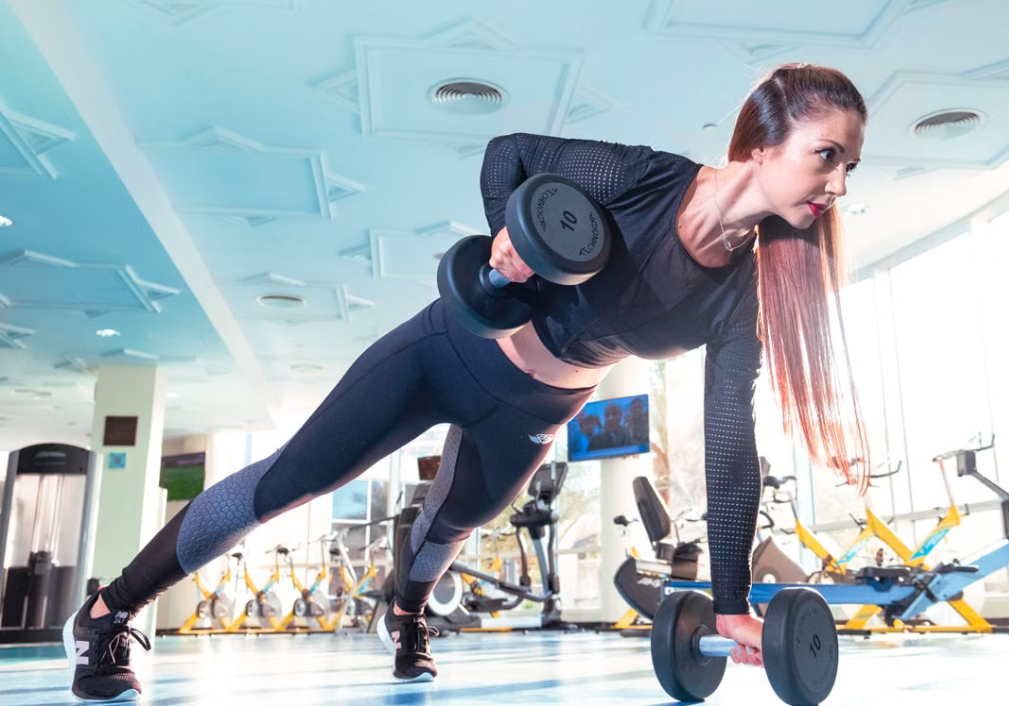
For a dumbbell row, stand with your feet about hip-width apart and hinge forward at the hips. Keep your back in a comfortable neutral position and let the weights hang beneath your shoulders. Pull your elbows backward toward your hips, then lower the weights slowly.
Start with two or three sets of 8–12 repetitions using a resistance level you can control.
Avoid jerking your torso or rounding your back to move a heavier weight. A controlled repetition with appropriate resistance is generally more productive than a heavier repetition performed with poor technique.
7. Step-Ups: Combine Strength and Cardiovascular Fitness
<text> </text>
<AsyncImage query=”person performing step up exercise on low stable exercise platform fitness workout” aspectRatio=”16:9″ width=”100%” />
Step-ups mimic the everyday movement of climbing stairs while challenging the legs and cardiovascular system. They’re also easy to scale according to the height of the step and your current fitness level.
Stand in front of a low, stable platform. Place one foot fully on the platform and press through that foot to bring your body upward. Step down carefully, then repeat on the same side or alternate legs.
Begin with six to ten repetitions per leg. Use a low step at first, especially if you have limited balance or knee discomfort.
Keep the movement controlled rather than pushing off aggressively with the leg remaining on the floor. Make sure the platform cannot slide or tip.
As your fitness improves, you can increase the number of repetitions or extend the total working time. Step-ups can also serve as a low-impact alternative to jumping exercises.
8. Mountain Climbers: Add a Cardio Challenge
<text> </text>
<AsyncImage query=”person performing mountain climbers exercise high plank knees driving forward fitness demonstration” aspectRatio=”16:9″ width=”100%” />
Mountain climbers combine a plank position with alternating knee drives. They challenge core stability and can raise your heart rate, making them useful when you want to add a more dynamic element to your routine.
Begin in a high plank with your hands beneath your shoulders. Bring one knee toward your chest, return that foot, and repeat with the other leg. Continue alternating while keeping your torso as steady as possible.
Start slowly for 15–20 seconds, rest, and repeat two or three times. Increase your pace only when you can maintain stable shoulders and controlled movement.
You don’t need to sprint. Faster repetitions can make the exercise more demanding, but speed should never replace technique. If the floor position feels uncomfortable, try standing knee drives or use an elevated surface for your hands.
Because mountain climbers can be demanding, they may not be suitable for everyone. Choose a gentler alternative if the movement aggravates your wrists, shoulders, or knees.
9. Dead Bugs: Train Core Control
<text> </text>
<AsyncImage query=”person performing dead bug core exercise on back opposite arm and leg extended fitness mat” aspectRatio=”16:9″ width=”100%” />
Dead bugs are a controlled core exercise that teaches you to move your arms and legs while keeping your trunk stable. Unlike fast-paced exercises, they emphasize coordination and precision.
Lie on your back with your arms extended toward the ceiling and your knees bent at approximately 90 degrees. Slowly lower one arm behind your head while extending the opposite leg. Return to the starting position and switch sides.
Keep your lower back in a comfortable, controlled position throughout the movement. Only extend your limbs as far as you can without losing stability.
Start with six to eight repetitions per side for two sets. Move slowly, exhale as you extend your limbs, and avoid holding your breath.
Dead bugs can be especially helpful for beginners learning core control before progressing to more demanding exercises. If the movement feels too difficult, move only your legs or arms at first.
10. Brisk Walking: Support Endurance and Recovery
<text> </text>
<AsyncImage query=”person brisk walking outdoors on park path athletic shoes morning exercise” aspectRatio=”16:9″ width=”100%” />
Walking may look less demanding than strength training, but it plays an important role in a balanced fitness program. Brisk walking supports cardiovascular health, increases daily movement, and can help you recover between more challenging workouts.
Walk at a pace that noticeably increases your breathing while still allowing you to speak in sentences. Begin with 10–20 minutes if you’re currently inactive, then gradually increase your duration.
The general public-health target for adults is at least 150 minutes of moderate-intensity aerobic activity per week, alongside muscle-strengthening activity on two or more days. You can build toward that target gradually according to your ability and medical circumstances.
Walking also offers a practical advantage: it can fit into lunch breaks, errands, or a short evening routine. You don’t need to turn every session into an intense workout to benefit from regular movement.
In hot weather, choose cooler times of day, drink water, wear suitable footwear, and stop if you feel dizzy, unusually weak, or unwell.
How to Combine These Exercises Into a Weekly Routine
You don’t need to perform all ten exercises in a single session. A better strategy is to combine strength movements into two or three manageable workouts and add walking throughout the week.
A Beginner-Friendly Full-Body Workout
Try this routine two days per week, with a rest day or lighter activity between sessions:
- Bodyweight squats: 8–12 repetitions
- Incline push-ups: 5–10 repetitions
- Glute bridges: 10–15 repetitions
- Bent-over rows: 8–12 repetitions
- Dead bugs: 6–8 repetitions per side
- Plank: 10–20 seconds
Complete one or two rounds initially. Rest as needed between exercises, and prioritize controlled technique over speed.
On other days, take a comfortable walk or add a short session of step-ups and mountain climbers if your fitness level allows. You can use lunges as an alternative to squats on some days, rather than adding every lower-body exercise to the same workout.
How to Progress as You Get Stronger
Progressive overload means gradually increasing the challenge your muscles face. It can involve adding repetitions, performing another set, using more resistance, or choosing a slightly harder variation.
For example, you might begin with eight squats per set. When you can complete all your repetitions comfortably with good technique, increase the number gradually or introduce a light dumbbell.
Change one variable at a time. Increasing resistance, workout duration, and exercise difficulty all at once can make it harder to assess your recovery.
Keep track of your workouts in a notebook or fitness app. Small improvements—an extra repetition, steadier balance, or a longer controlled hold—are meaningful signs of progress.
Nutrition and Recovery for a Stronger, Leaner Body
Exercise provides the stimulus for adaptation, but your body also needs sufficient energy, nutrients, and rest. Training harder while consistently under-eating or sleeping poorly can undermine performance and recovery.
Eat Enough Protein and Balanced Meals
Protein supplies amino acids needed for muscle repair and growth. Suitable sources include eggs, fish, poultry, dairy products, tofu, beans, lentils, and other legumes.
Pair protein-rich foods with vegetables, fruit, whole grains, and sources of healthy fats. This approach supports a broad range of nutritional needs without requiring an overly restrictive diet.
If fat loss is part of your goal, avoid aggressive calorie restriction. A moderate, sustainable approach is more likely to preserve training performance and lean mass than crash dieting.
Supplements are not essential for most beginners. Start by establishing consistent meals, adequate hydration, and a training routine you can maintain.
Prioritize Sleep, Rest, and Recovery
Muscles adapt between workouts, not simply during the exercise itself. Recovery allows your body to respond to training and helps you maintain consistent performance.
Many adults benefit from approximately seven to nine hours of sleep per night, although individual needs vary. Regular sleep schedules, a comfortable sleeping environment, and limiting late-day caffeine can support better rest.
Allow muscle groups time to recover between demanding sessions. Mild soreness can occur after unfamiliar exercise, but sharp pain, worsening joint discomfort, or persistent symptoms should not be ignored.
Common Workout Mistakes That Slow Progress
One common mistake is doing too much too soon. Starting with daily high-intensity sessions can cause excessive soreness and make exercise difficult to sustain. Begin at a manageable level and increase your workload gradually.
Another mistake is sacrificing technique to complete more repetitions. Poorly controlled movements may reduce the intended training benefit and increase the risk of injury. Reduce the resistance or choose an easier variation whenever you cannot maintain control.
Some people focus entirely on cardio while neglecting strength training. Others train intensely but overlook sleep, nutrition, and daily activity. A balanced approach combines resistance exercise, aerobic movement, recovery, and consistent eating habits.
Finally, avoid judging progress by the scale alone. Changes in strength, energy, endurance, balance, clothing fit, and exercise performance can all provide useful information. Body weight naturally fluctuates, and visible changes may take time.
Conclusion
Building a stronger, leaner body starts with simple movements performed consistently and with good technique. Squats, push-ups, lunges, planks, glute bridges, rows, step-ups, mountain climbers, dead bugs, and brisk walking offer a flexible foundation for improving strength, stability, and cardiovascular fitness.
The most effective routine is not necessarily the hardest one. It’s the routine you can follow, recover from, and gradually improve. Combine appropriate resistance training with regular movement, balanced nutrition, and adequate sleep, and you create the conditions for lasting progress.
Start with a few exercises, track your improvements, and increase the challenge when you’re ready. You don’t need to transform everything overnight. Small, repeatable actions are what turn a fitness goal into a sustainable habit.